Explore
Discover New Milford’s rich history, classic New England charm, scenic landscapes, places of worship, boarding schools, day camps, and arts centers, offering opportunities for learning, creativity, and exploration.


Built after the Great Fire of 1902, the United Bank Building rose from the ashes of the New England House tavern and neighboring banks destroyed in the blaze. The New Milford Savings Bank and First National Bank quickly partnered to construct a shared facility on the site, serving the community for decades—most recently as Webster Bank.
Though much of the building later fell into disrepair, its historic significance—recognized by its 1982 listing on the National Register of Historic Places—led to its revival. In 2015, Village Green Investments transformed the space in just nine months into 19Main, Litchfield County’s premier event venue. Today, the building blends modern amenities with historic charm, with three original bank vaults still preserved as a nod to its past.
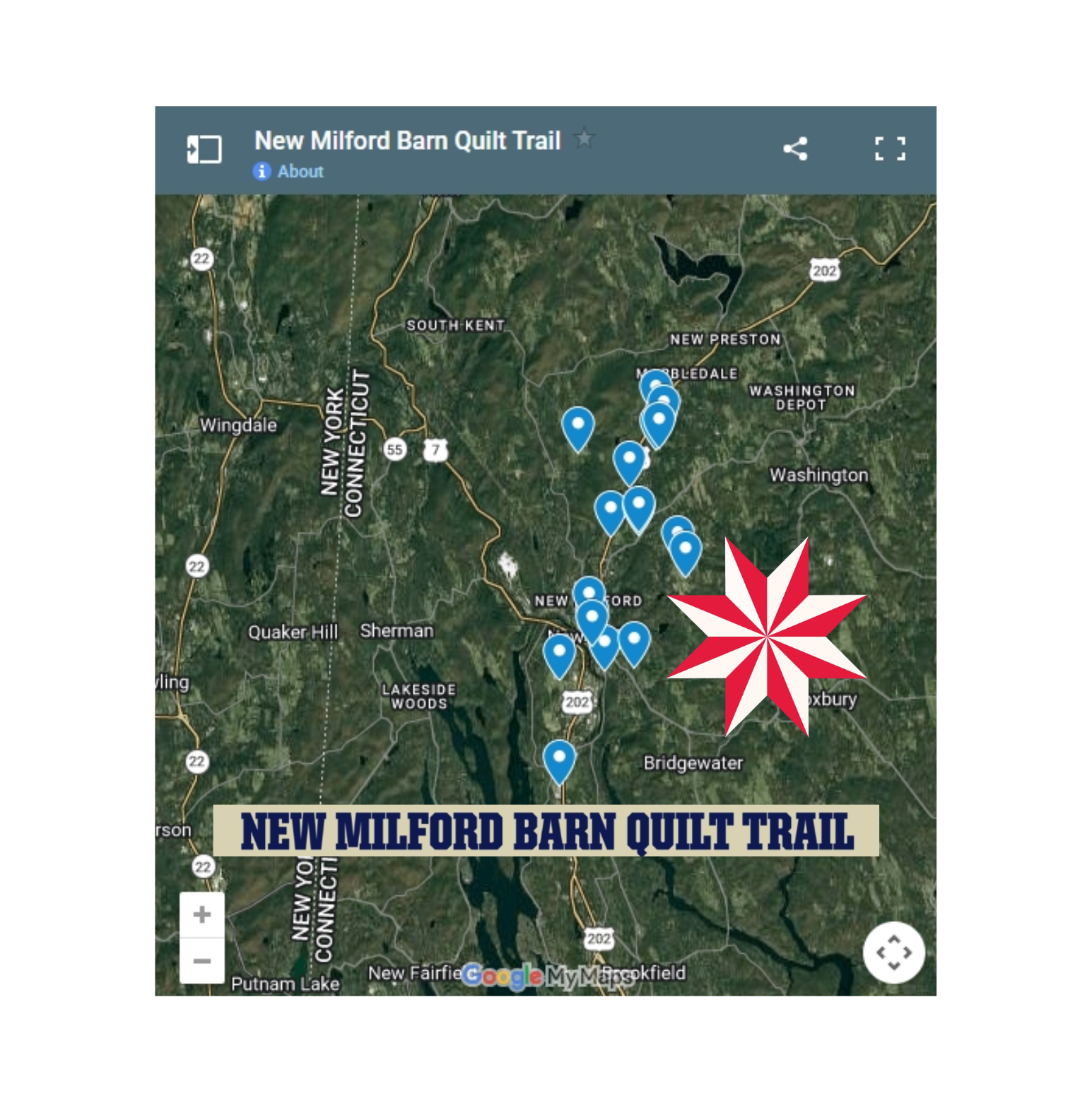
Are you Interested in having a barn quilt block on your local property considered for inclusion on the New Milford Barn Quilt Trail? The New Milford Barn Quilt Trail consists of 19 colorful quilt patterns hand-painted on large weather-resistant blocks and hung on antique and vintage barns and historical buildings around our town. It honors our rich agricultural history, the exciting resurgence of family farms in New Milford today and the American tradition of quilt-making. It is the first barn quilt trail established in Connecticut. Already, over 40 U.S. states, including New Hampshire and New York, boast quilt trails in a rapidly expanding movement that began in Ohio in 2001. Get in your car or jump on your bike and use any mobile device to access this site as you visit these barn quilt block sites.
Learn more about participating!!👇🏼CLICK THE LINK BELOW👇🏼
https://newmilfordfarmlandpres.org/barn-quilt-trail-2021/

The Barn Quilt Trail was created to showcase New Milford’s many antique and historic barns while celebrating the town’s deep agricultural roots. The trail features 19 colorful quilt patterns, hand-painted on large weather-resistant panels and displayed on barns and historic buildings throughout town. Honoring New Milford’s farming heritage, the revival of family farms, and the enduring American tradition of quilt-making, the trail is also the first of its kind in Connecticut.
Since the movement began in Ohio in 2001, barn quilt trails have appeared in more than 40 states, including New Hampshire and New York. Explore the trail by car or bike and use any mobile device to access the informational website as you visit each location. A trail map is also available at New Milford Town Hall.

glassblowing, puppetry, printmaking, silkscreening, flame work, and book binding

Canterbury School, at the top of Aspetuck Avenue, includes the property once known as Ingleside School, established in 1890 by Sarah Sanford Black, widow of William Black, of Ball, Black & Company, Tiffany’s rival jewelry store. The Black mansion on Hickory Hearth was destroyed by fire, but the gatehouse to the mansion at 73 Aspetuck Avenue remains. Behind the gatehouse is the first well dug in New Milford. Canterbury, a private college preparatory school established in 1915 by Nelson Hume, has flourished on the Ingleside grounds and land to the north. Its English Collegiate Gothic chapel was designed by architect Raphael Hume and built in 1927. It contains stained glass windows by D’Ascenzio Studios of Philadelphia. D’Ascenzio also did windows for the Folger Shakespeare Library, the National Cathedral in Washington, D.C., and the Riverside Church in New York City. A mile marker erected in 1788 by Zachariah Sanford, Sarah Sanford Black’s grandfather, stands near the chapel.

A walk through this 300-year-old cemetery that lies just a block from the town green offers a window into New Milford’s colorful past. Among its rolling hills and lush grounds, you’ll see the names of the town’s original settlers, along with 50 Revolutionary War soldiers. Other notables buried here: NFL star Francis “Hap” Moran, who played for the New York Giants from 1929 to 1933; and character actor Karl Swenson, whose numerous roles included the kindly lumber mill owner Lars Hanson on TV’s “Little House on the Prairie.”

Create Escape Studio is a Contemporary Art Studio that specializes in providing a relaxing, comfortable, and inspiring environment for artists and non-artists to explore their creative side.
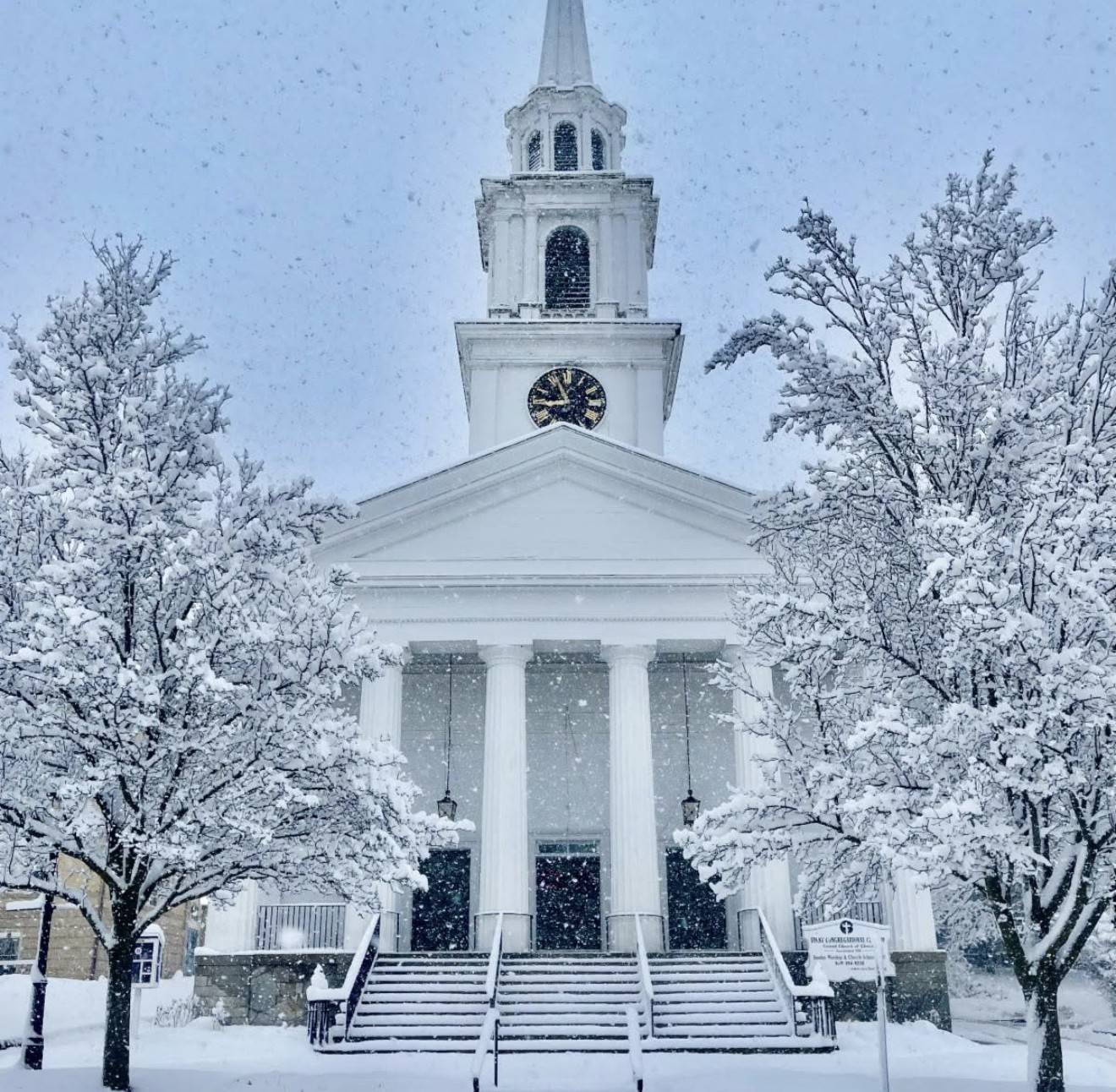
Join us Sunday mornings at 10am for worship and church school in a welcoming and historic setting. Built in 1830, the church is a beautiful example of Greek Revival architecture, featuring a classic temple-front design with a gable end pediment supported by six large fluted Doric columns. The steeple rises in four graceful stages, and inside, stunning stained glass windows—including one created by Tiffany—add to the beauty of the space.
Beyond Sunday services, connect with one of our groups engaged in meaningful community activities and opportunities for personal growth. If you enjoy music, consider joining the adult choir or the Village Ringers bell choir. Additional ministries include Prayer Shawl and quilt-making, the Baby Bundles ministry, and more—we warmly welcome everyone.

Our mission is to develop, encourage, promote, and protect the commercial, industrial, professional and general business interests of the community; and to promote the civic interests and general welfare of the town of New Milford and its trade area.
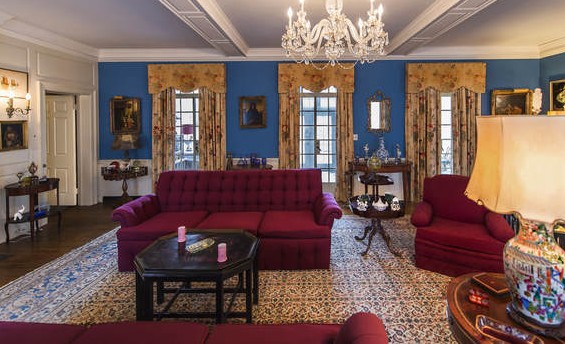
The Harden House, now a museum, is located in Harrybrooke Park in the southern end of New Milford. The cabana style house was built in 1941 by Irish-born Frank Harden, who owned the world’s largest handkerchief factory in New Jersey. The house, which overlooks a waterfall on the Still River, contains original artwork and furniture specific to the mid-twentieth century. The building is on the Connecticut Register of Historic Places. Harrybrooke Park and Harden House is a 48-acre, non-profit park bordering the Still River. It contains walking trails, gardens, a playground, two pavilions, a duck pond, and hosts a pair of peacocks. Harden House Museum is situated near the waterfall on the Still River.

Built in 1900-02, this 5.5 story brick building was used for tobacco sorting, curing, and warehousing until the 1930s. It is the region's largest surviving tobacco warehouse.

Welcome to Junie’s Cottage—accommodations at the Hunt Hill Farm Trust.
Please note: This is not a standard rental. We are a 501(c)(3) nonprofit Living Museum, and 100% of the proceeds from your stay serve as a direct donation supporting the preservation of our 18th- and 19th-century National Register historic landmarks. By staying with us, you are actively helping to preserve Connecticut’s rich history.
Experience an immersive retreat in a true oasis of culture, music, arts, and conservation. Hunt Hill Farm was the birthplace of the New York Pops Orchestra in 1983—now the largest independent orchestra in the nation. Our campus is also home to the Skitch Henderson Museum, the first Smithsonian Affiliate Museum of American Music History, where visitors can explore the rich legacy of American music.

Just In Antiques & More offers a welcoming, treasure-filled experience for anyone who loves vintage charm and one-of-a-kind finds. Owner Justin Krul is always on the hunt, exploring barns, attics, and basements across the Northeast to uncover unique, high-quality antiques—each piece chosen with care and offered at a fair price.
The shop itself is as remarkable as the items inside. Housed in a stunning Federal Georgian–style home built in the 1820s, the building showcases craftsmanship using locally sourced brick, glass, and ironwork. This two-and-a-half-story historic residence features four fireplaces, an elegant front entrance framed by pilasters, a graceful portico with round columns, and a striking Palladian window.
Its beauty has long been recognized. Celebrated author Edna Ferber famously described it in her 1930 novel American Beauty as “the most beautiful house in America.” In 1977, the property was officially listed on the National Register of Historic Places. Today, this extraordinary home continues its story as Just In Antiques & More—a place where history, character, and discovery come together under one unforgettable roof.

Specializes in estate clean outs, household buyouts, estate liquidations services, and barn, basement and attic clean outs and liquidations. Owner Loretta Kretchko, who formerly conducted estate sales under Litchfield Hills Estate Sales Service, has over 35 years experience buying, selling and appraising antiques in Connecticut and New York.

Funky and eclectic group shop with a large variety of antiques that will take you back in time.

Lillis Funeral Home stands at this historic location, serving families with care and compassion while carrying forward the site’s long-standing connection to the community. The original house, built in 1823 or 1824 for Royal Canfield, was later transformed in 1910 by architect Ehrick Rossiter into a Greek Revival residence for Charles Merritt Beach. The Beach family lived here until 1961.

The Mission of the John J. McCarthy Observatory is to further science literacy, both for students and adults of the Western Connecticut region. With the great appeal of Astronomy, it is a natural tool for creating scientific curiosity and reinforcing interest and skills in science. Join us for our open to the public star party on the Second Saturday of every month! No reservations required and admission is always free. Each month a new presentation is given on an astronomy related topic. If weather permits, a variety of telescopes are available for public viewing of seasonal celestial objects. The observatory, which is ADA compliant, may also host special viewing events when possible for rare or interesting astronomical phenomena such as eclipses and transits. There is ample parking at the front of the building. The observatory is located on the south west side of the New Milford High School grounds, in the rear of the south parking lot next to the football field. Donations are gratefully accepted.

The Merryall Union Evangelical Society Chapel is a historic church building on Chapel Hill Road in New Milford, Connecticut. Built in 1890, it is the town's best example of Carpenter Gothic architecture. It is used in the summertime for services by visiting ministers of diverse denominations, and hosts weddings and other private functions. It was listed on the National Register of Historic Places in 1986. Referred to as the Merryall Chapel, it stands in a rural setting about 4 miles north of the center of New Milford, on the west side of Chapel Hill Road. It is a single-story wood frame structure, with a steeply pitched gabled roof and clapboarded exterior. A square tower projects from the center of the street-facing front facade, rising to a pyramidal roof and fleur-du-lis finial. The entrance is in the base of the tower, topped by a lancet-arched panel. Lancet-arch windows line the side walls. The interior is decorated in a Victorian style, with spindle-backed chairs for seating of the congregation, and a raised platform at the rear serves as the altar, furnished with velvet armchairs and couch. The Merryall Union Evangelical Association was founded in 1884 as a vehicle to provide Sunday School education to children in the area. The present chapel was an outgrowth of that organization, which expanded to offer regular services to local residents, who would otherwise have to make the sometimes difficult journey to the town center for services. Services were typically provided by traveling ministers or ministers from other area churches, and were usually non-denominational. About 1900, care of the building fell to a local sewing club, and services were regularly offered during the summer, bringing in summer residents of the area. A new nonprofit was established in the 1970s to oversee maintenance of the building.

Merryall is the place to go for off-the-beaten-path entertainment. For nearly 70 years, Merryall center has provided unique theater, music and lectures performed in a magical, cozy space like no other. It’s the off-Broadway, Greenwich Village cabaret and speakeasy of Litchfield County where you never quite know what to expect, but you’ll always leave wanting to come back for more. Merryall Center is dedicated to social, educational and cultural exchange enhancing life in the Litchfield Hills.

Merwinsville Hotel in Gaylordsville was built in 1842-3 as a hotel and railroad station by Sylvanus Merwin. A three-story wood-frame building, it is one of oldest hotels built specifically for a railroad stop in the U.S. The third floor ballroom is currently being renovated. After rail service ended in 1915, it was used as a private residence into the 1940s when it became vacant until it was restored in the 1970s.


Antiques & collectibles. Specializes in wooden furniture restoration.

This scenic walkable downtown district features boutiques, retail shops, restaurants and other businesses housed in buildings that take you as far back as the 18th century. From the striking Greek Revival-style Congregational Church to the early 20th-century brick Allen Building, you’ll take in an array of architectural styles. The Nathaniel Taylor house, built in the Colonial style in 1774, played host to several significant Revolutionary War figures, among them the Marquis de Lafayette and the Comte de Rochambeau. To further quench your thirst for history, check out the New Milford Historical Society & Museum, with exhibits that explore everything from the town’s rich agricultural roots and its thriving tobacco industry to maps of the Underground Railroad, a series of places in town where enslaved people could take refuge on their path to freedom in Canada. A monument dedicated to the memory of enslaved people stands at the Historical Society & Museum in front of the Lincoln memorial at the north end of the town green.

NEW MILFORD'S PUBLIC HIGH SCHOOL GRADE 9-12
The state-of-the-art high school, home to the world-class John J. McCarthy Observatory, doubles as a venue for community, educational and cultural events ranging from PTO meetings to theater productions. Among the facilities available for rent are its theater, an arena, the gym, library, cafeteria, kitchen, classrooms, even the turf fields. Fees vary depending on the type of organization (nonprofit, recreational, commercial, etc.) that wishes to rent.

The New Milford Historical Society and Museum was founded in 1915. Our campus includes a gallery with an attached historic house, the Knapp House, c. 1815, and the attached Boardman Store, c. 1793 and Litchfield County’s First Bank building, c. 1820. The museum collects, preserves and interprets objects and information of historical merit pertaining to the backgrounds of individuals and their way of life and customs.

The library had humble beginnings, initially housed in the homes of private citizens in the 1790s. A century later, it had its own building that featured Memorial Hall, a second-floor room initially set aside to honor the town’s Civil War veterans. It turned into a civic meeting place as well, especially for the Grand Army of the Republic, an organization that fought for numerous causes, including voting rights for African Americans and veterans pensions. Today, a major renovation is underway that will marry the library’s storied history with state-of-the-art facilities to meet 21st-century living. A connector will link the original 1890s stone Richardsonian Romanesque Revival-style building with its 1970s addition, and a new high-tech collaborative makerspace will cater to those interested in robotics, 3D printing and STEM learning. Memorial Hall, which can hold 155 people, will once again double as a community meeting place. A grand reopening is planned for January 2022.
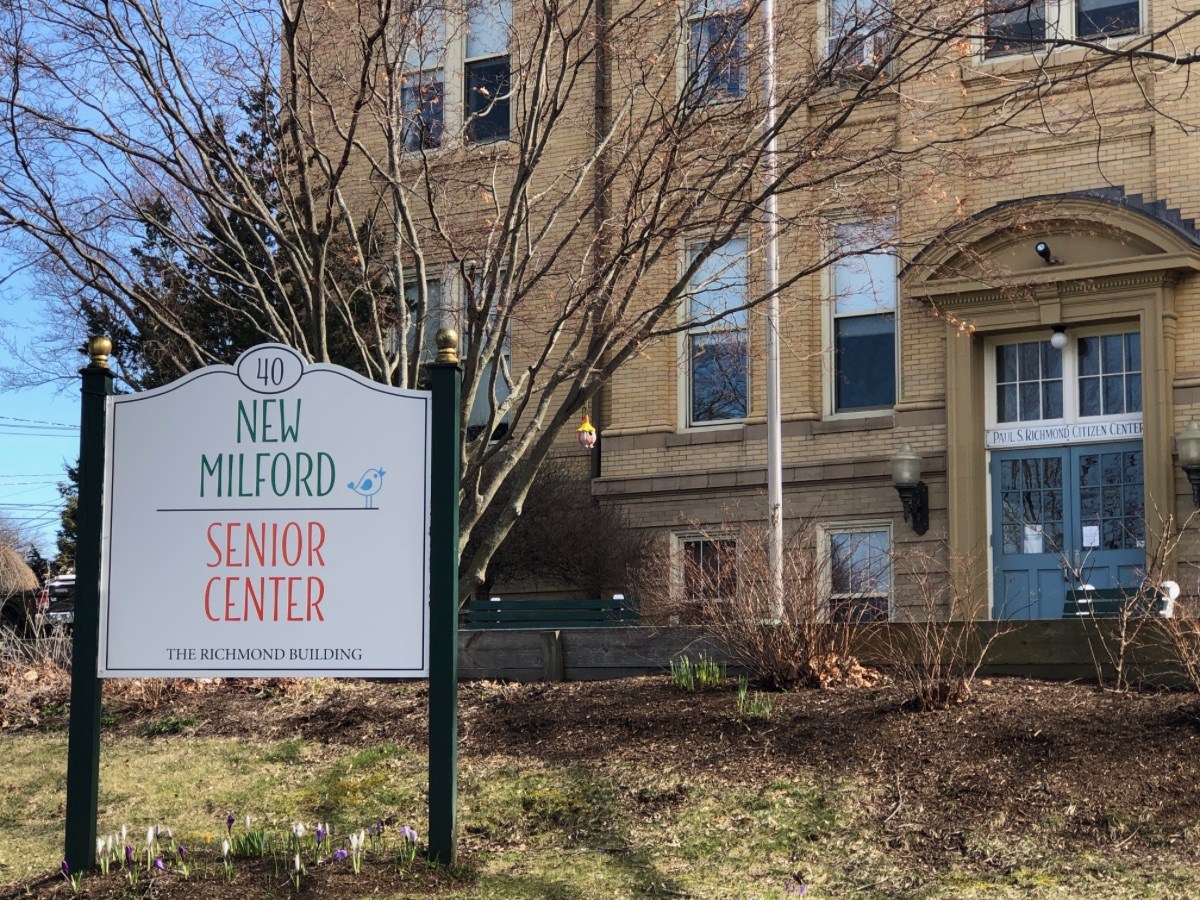
We are happy to provide social/recreational, educational, nutritional, and health and wellness services, to our 60 and over community! The building was built as a school around 1910-11 and was known as New Milford High School. In 1931, a new high school was built at 50 East St. and this building on Main Street became the Main Street School for elementary students. It was building was repurposed as town office space in 1980s. In June 1984, the building was rededicated as the Paul S. Richmond Citizen Center and the town's senior center moved in.
OPEN TO THE PUBLIC.
RENTAL AVAILABLE TO NEW MILFORD RESIDENTS ONLY.
SEE WEBSITE FOR APPLICABLE PASS OR PERMIT FEES.
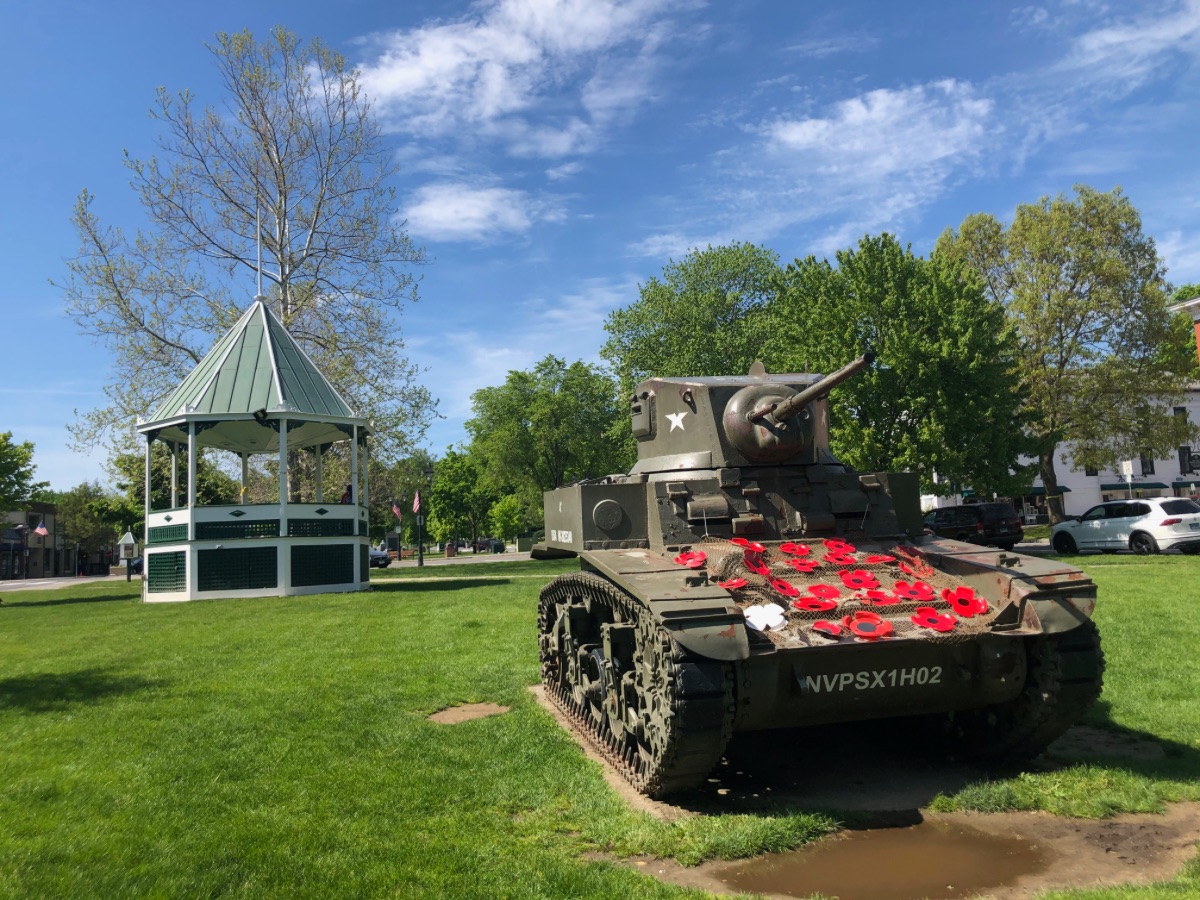
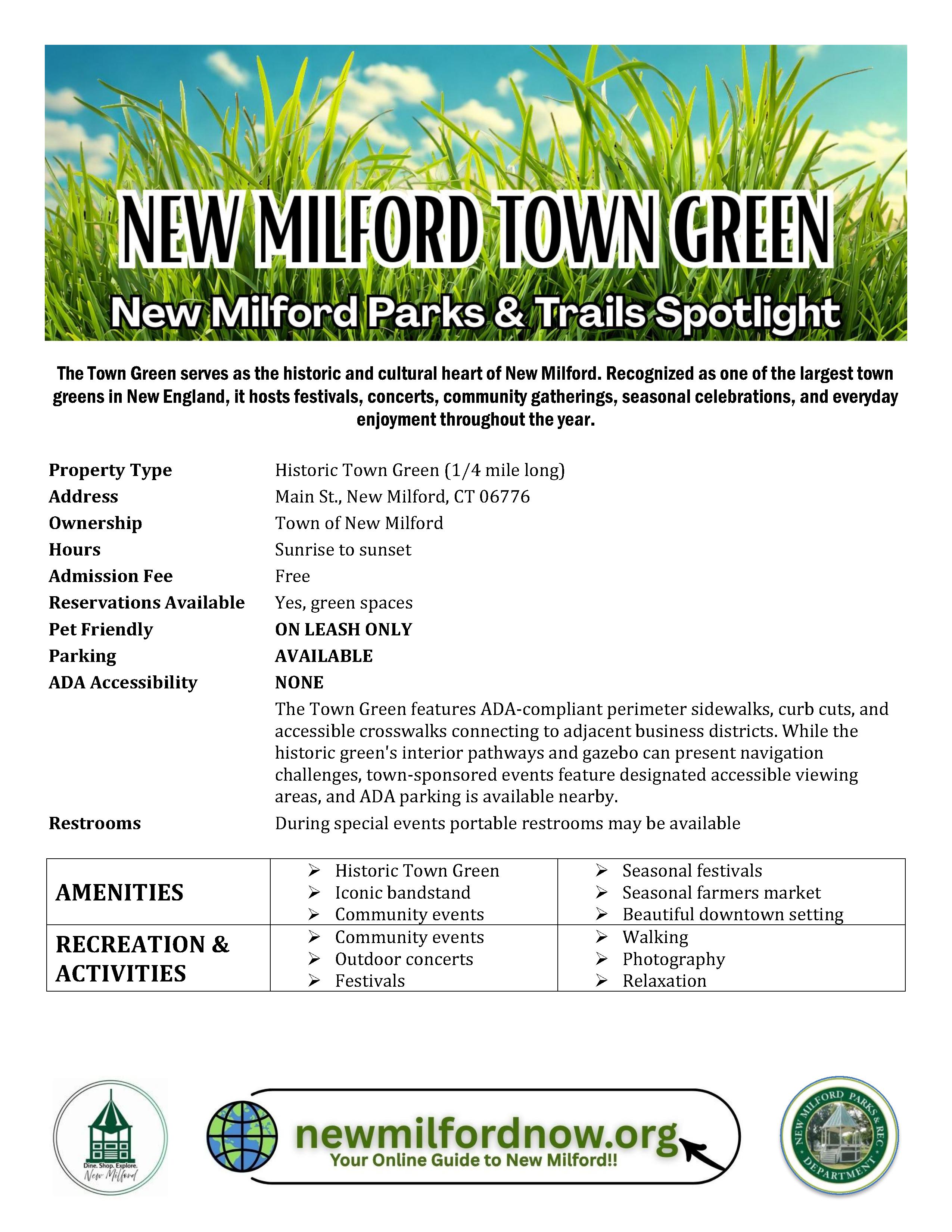
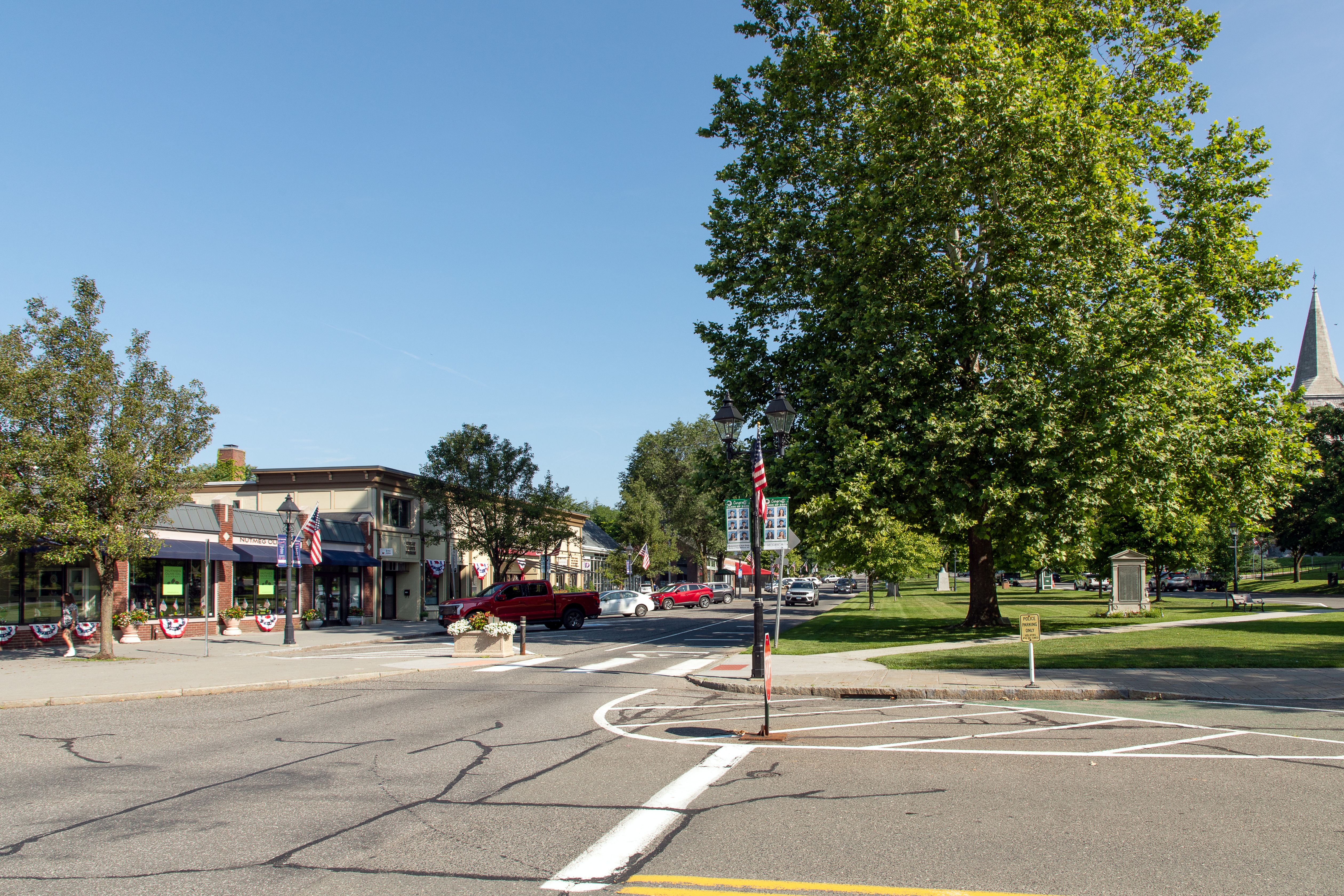
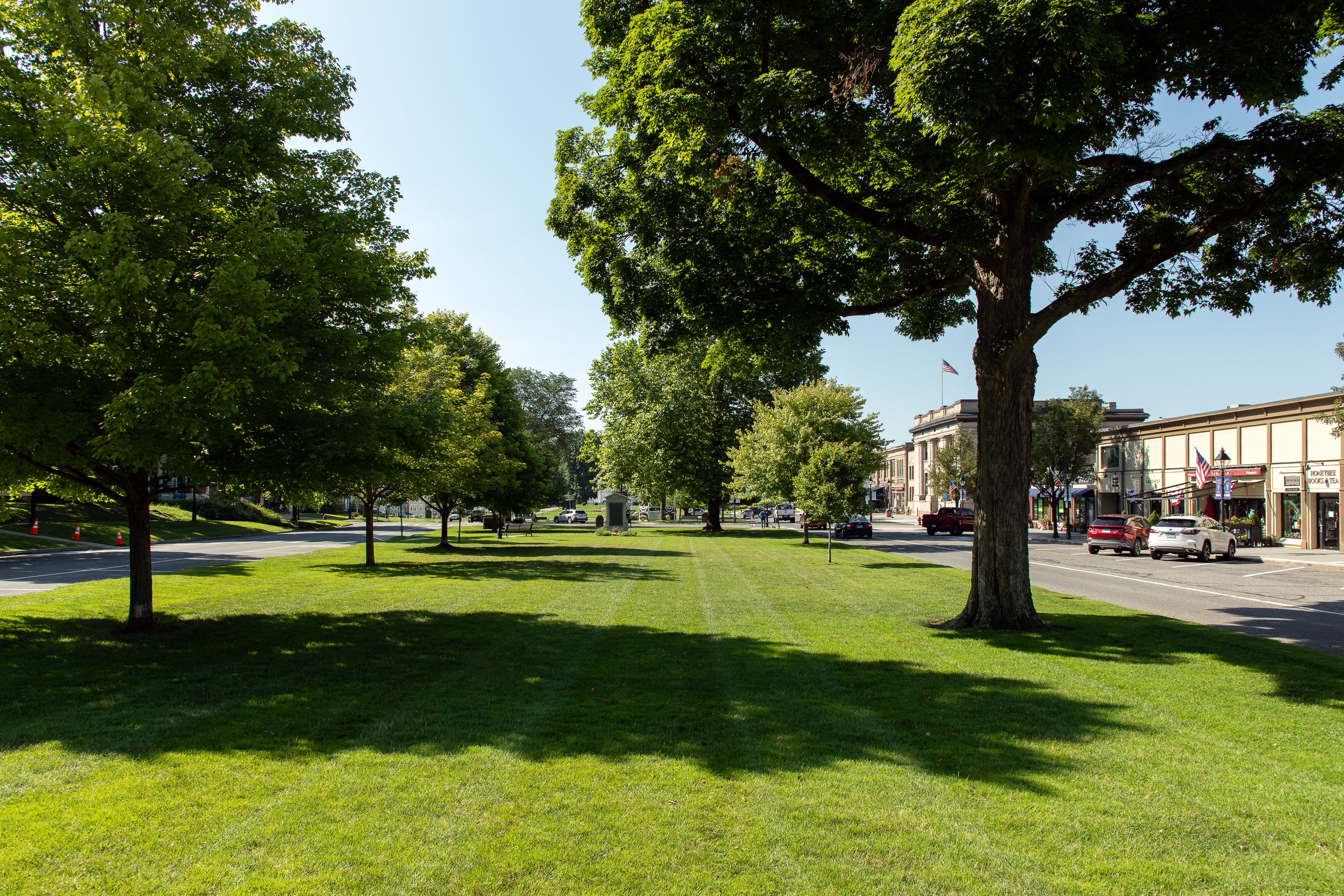
The three-block rectangular town green, one of the longest in Connecticut, sits in the heart of downtown and is a hub of year-round activity. It hosts concerts from its iconic bandstand built in 1891, holiday parades and events, and arts festivals. If you’re a history buff, check out the monuments that dot the Green – and you can’t miss the Stuart Army tank, a memorial to war veterans that has stood on the Green since the 1940s. Rentals available.

The land for this wooden structure was purchased in 1862. Originally it held classes for 1st through 8th grade, and in its later years contained grades one through six. It was shut down as part of the consolidation of New Milford schools, and after 1955 Northville students traveled to schools in the center of town. In 2002, Mr. Truman Richmond recalled that when he attended in the 1920’s, the schoolroom was surrounded by blackboards and students sat facing the teacher’s desk which was located on a raised platform in the front of the room. The desks varied in size, with the smallest at the very front of the room near the teacher’s desk. A round woodstove in the front of the teacher’s desk heated the building. At the buildings’ entrance, the boys’ cloakroom was on the left and the girls’ on the right. For bathrooms, students were excused to use unheated outhouses behind the school. Older students usually performed daily chores, such as fetching water from a spring, chopping wood for the stove, and sweeping floors. the northville one room school houseFor many years the Northville Volunteer fire Company used the building for storage. The town owns the schoolhouse now and the Northville Schoolhouse Committee oversees its maintenance and use.

A hike through Sega Meadows Park will bring you near the Old Boardman Bridge, the longest (at 188 feet) of Connecticut’s three surviving lenticular truss wrought-iron bridges. The Berlin Iron Company of Berlin, Connecticut, built the span over the Housatonic River in 1887-88, adorning it with several ornamental touches: latticework, winged orb finials and floral motifs above the portals. The bridge was named after the Boardman family, who descended from New Milford’s first minister. It helped connect local farmers, nearby lime quarries and a workers village that had its own school, store and train stop. The New Milford Trust for Historic Preservation donated an informational sign in 2018 that’s posted at the west end of the bridge. A painting of the bridge, done in the 1970s by renowned New Milford artist Woldemar Neufeld, hangs in Town Hall. Though long closed to foot and vehicular traffic, efforts are ongoing to restore and reopen the bridge to pedestrians.

The Pratt Nature Center, (founded in 1967) is a 205-acre wildlife preserve and environmental education center in Litchfield County, CT. The land is diverse – with a mountain, meadows, woods, wildlife, gardens, farm animals, a stream, a pond, and wetlands, providing wonderful opportunities for outdoor fun, discovery and adventure! Pratt Nature Center offers hiking, bird-watching, community garden plots and nature education for all ages including programs tailor-made for the classroom or scout troop as well as for family or community enjoyment and learning.

Reis Learning Center provides 1:1 academic support to school-aged students across a variety of skill levels. At RLC, each student is treated to an individualized academic program that caters to his or her specific needs. These programs will help fill in any gaps they may have in their learning history, promote positive study habits, and foster self advocation skills. We work with students to not only increase their academic knowledge, but also to foster personal growth and increase self-esteem. Classes, Workshops, and Handmade Gifts: Our small group events provide creative opportunities for children, teens, and adults. While you attend one of our artisan workshops, guests are also invited to shop our curated collection of locally handmade gifts.


New Milford Town Hall, home to the town’s municipal government offices, is richly steeped in history. It bears the name of one of the community’s most notable residents, Roger Sherman, the only individual to have signed all four foundational documents of the United States: the Articles of Association of the First Continental Congress, the Declaration of Independence, the Articles of Confederation, and the U.S. Constitution.
The brick town hall stands on the site where the prominent businessman, lawyer, and statesman once lived. Facing the town green, the Colonial Revival-style building retains its 19th-century character, with many original doors, windows, and hardware still intact. Today, it functions both as the center of municipal government and as a historic backdrop to New Milford’s everyday civic life.

100% Customer Satisfaction Since 1946 ~ When Only The Best Will Do. Ruth Chase Flowers is located in a beautifully preserved 1889 building, showcasing classic late-19th century neo-Gothic architecture.

St. Peter’s was built by the Episcopal Church. Previously known as All Saints Church, it is a stone church of Gothic design with many of the stunning features typical of that time period including a slate roof, oak beams, stained glass windows, etc. It was purchased by St. Peter’s Temple Association, Inc. in 1963 to manage the operation of the building and was refurbished to include a lower level with a large kitchen and spacious dining area, utility, furnace and storage areas, as well as two bathrooms. In recent years, both the lower and upper levels have been refurbished to include many modern features. This 1882 neo-Gothic Church was designed by architect Ehrick Rossiter and commissioned by Mrs. David Sanford in memory of her husband, Judge David Sanford. In 1963, the St. Peter Temple Association bought it and still owns it.

OPEN TO THE PUBLIC.
SEE WEBSITE FOR APPLICABLE PASS OR PERMIT FEES.
Sunny Valley Preserve, part of The Nature Conservancy in Connecticut consists of 1,850 acres of farmland, forests, wetlands, and meadows on 19 parcels of land. It was donated by the late George D. Pratt Jr. Its variety of topography, geology and natural habitats supports diverse wildlife and biological communities. About 450 acres of the preserve are in active agriculture, and 1,200 acres consist of natural lands. There are 13 miles of recreational hiking trails and farm observation sites.
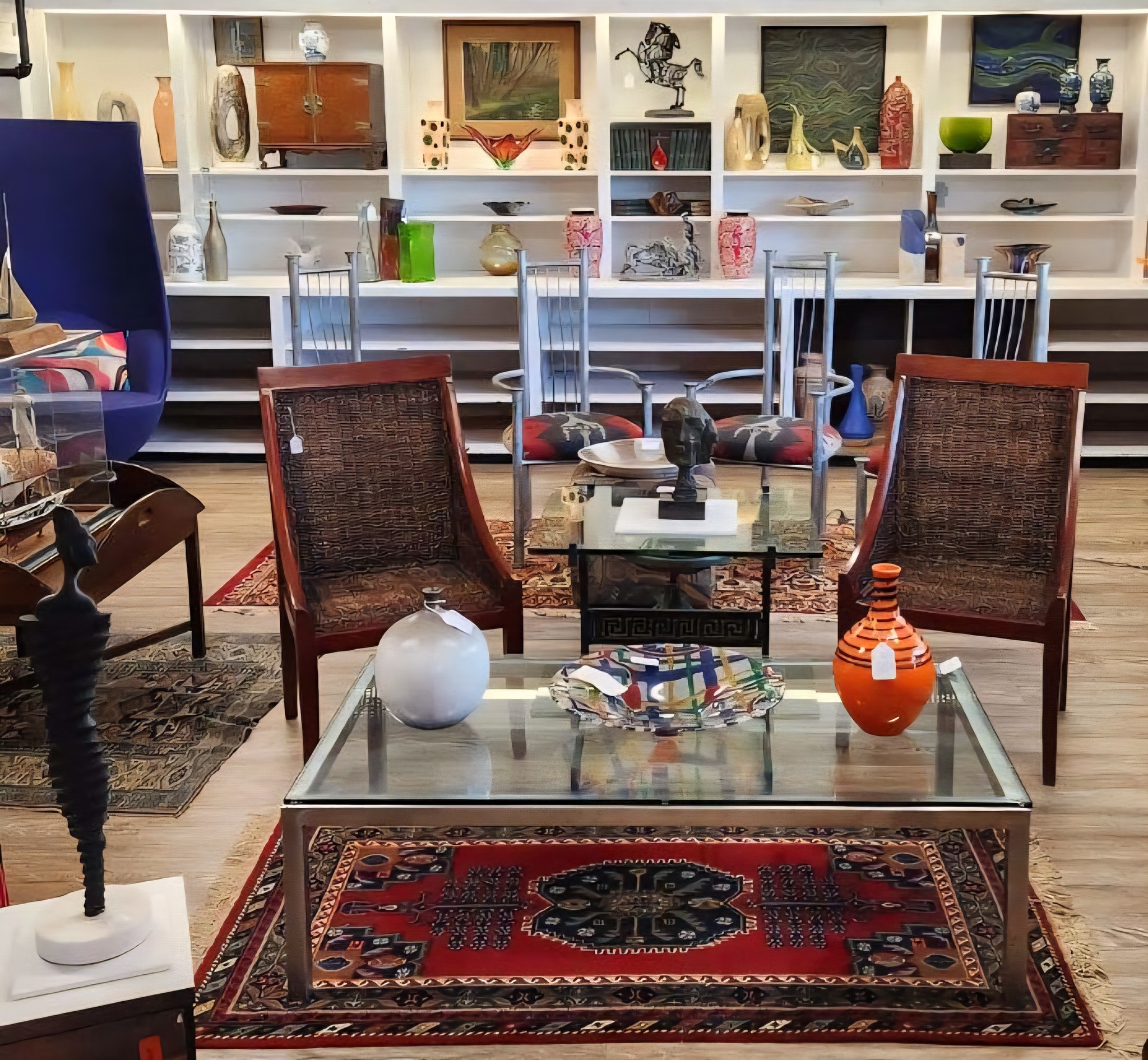

The Auction Barn holds monthly antique auctions, and weekly household and antique auctions.

This building was built in 1902 as a hotel and opened in 1920 as a theater. In 1937, it was remodeled. The 1930 Art Moderne facade is one of the best examples of the style in Connecticut. It has been remodeled or renovated several times since, most recently in 2007.

Built about 1875, this house is one of the finest examples of Italianate architecture in New Milford. The size and elaborate nature of the house reflect Bostwick's prosperity. It currently houses Union Savings Bank.

Built in 1793, this is the only example of the Georgian Style in New Milford. It boasts a Palladian window and four fluted Ionic columns framing the doorway. Elijah Boardman was a state and U. S. Senator and a prosperous merchant. Artist Ralph Earl's portrait of Boardman is part of the Metropolitan Art Museum's collection, and the New Milford Historical Society owns other Earl portraits of early New Milford residents.

Built in 1855 in a Greek Revival style, this is the second oldest house on Whittlesey Avenue. Gerardus Roberts had been a Captain in the Civil War and was an abolitionist, active in the Underground Railroad. Many of the later houses on the Avenue are of the Queen Anne style.

Our brick-and-mortar shop is filled with vintage treasures sourced from around the world, alongside thoughtfully chosen seasonal finds and reproductions. From unique home décor and furnishings to clothing, accessories, and collectibles, there’s something for every style and space. With new arrivals added daily, every visit offers a fresh, one-of-a-kind shopping experience.

Built in 1774, this Colonial house was bequeathed to the New Milford Trust for Historic Preservation in 2018. The Marquis de Lafayette visited the house during the Revolutionary War. The Trust is in the process of determining its use.

Hunt Hill Farm is a nonprofit institute and a center of learning for over 45 years, offering educational opportunities and experiences for children, youths and adults to nurture a deeper understanding of art, music, cooking, organic farming and land use. For over five decades, The Silo Cooking School has stood as a roaring testament as a part of the Hunt Hill Farm, celebrating the artistry, ingenuity, and sheer joy of cooking. This is the spot where culinary sparks turned into wildfires, where the seeds of what would become the Food Network were first sown in the 1970s—before cable took over our screens. It’s where titans of the culinary world like Julia Child, Jacques Pépin, and Martha Stewart—not just names, but legends—stepped into our kitchen, not only to teach but to capture the magic of food on film.
Now, the next chapter is being written. Under the inspired leadership of Chef Constantine “Dino” Kolitsas, owner of the celebrated award-winning restaurant Greca Mediterranean Kitchen + Bar, The Silo Cooking School / Greca Center of Culinary Excellence has reopened. Chef Dino comes with a clear vision and an unwavering drive.

The Spite House (a structure built intentionally to annoy other residents) was built in 1961. This five-tiered cake-type building is known not only for its unusual architecture but also for the story behind it. Jan Pol, the owner and builder, had taken in a foster daughter who became pregnant. Social services took the infant and its mother away against the protests of owner Pol and his wife. The “cake house” was built to house the infant, its mother, and Jan Pol and his wife, but this never happened so it became a “monument to injustice.”
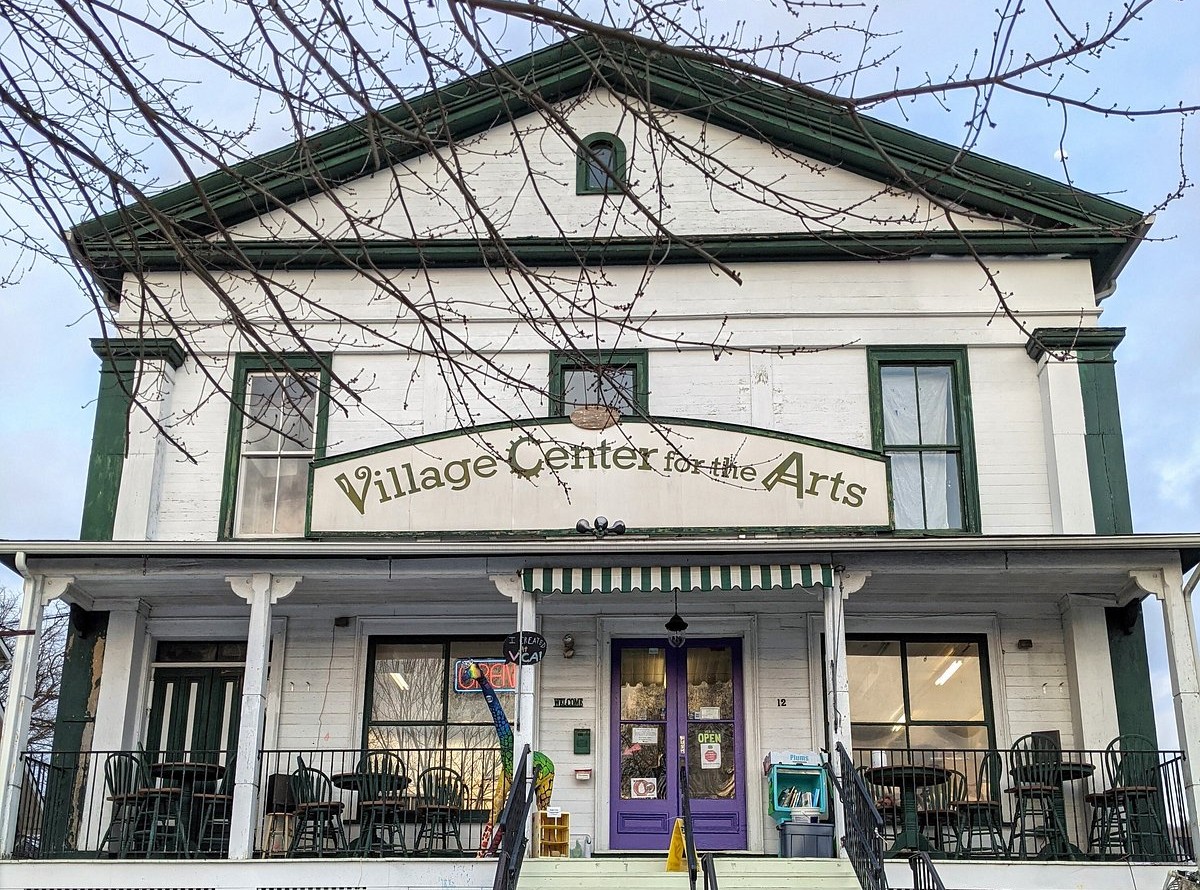
Located in the heart of downtown New Milford, the Village Center for the Arts is a lively creative hub where visitors can explore hands-on artistic experiences in a relaxed, welcoming setting. Housed in a charming historic building just steps from the town green, it blends local character with interactive fun.
The center is known for its “walk-in and create” approach, offering pottery wheel sessions, painting classes, and open studio time where guests of all ages can make their own art. Seasonal programs, workshops, and camps make it a popular destination for families, couples, and groups.
Whether you’re trying something new or simply looking to unwind, the Village Center for the Arts provides a memorable, creative stop that captures the artistic spirit of New Milford.